
The Ancient Tradition
Evidence presented in...
Episode #35- Ala-al-Din, Rukh & Makkah
Ala-al-Din, Rukh & Makkah
Interested in Learning More?
Episode #35 Transcript
(A.I. Generated)
00:00
Music
00:10
You’re listening to the Ancient Tradition. A Wonk Media Production. Music provided by Joseph McDade. He is your host, Dr. Jack Logan.
00:28
Welcome to the ancient tradition. I’m Jack Logan. Welcome back to all of you long time listeners. We’ve got a packed program today. If you’re new to the program and this is your first time listening in, we’re really glad that you’ve joined us. Here and there while you’re listening in, you might start to wonder what we’re talking about when we mentioned things like dragon’s lairs and special weapons and the son of the high god and concepts like ma’at and cedic, but.
00:55
Each of these are very, very important aspects of the theology that was taught by the ancients in the ancient tradition. We’ve set up the podcast so that each episode builds upon the previous episodes. So if you want to get a greater understanding of the things that we’re talking about on the program, the overarching theology taught by the ancients. I recommend after you give today’s episode a listen, that you start with episode number one and make your way through the episodes sequentially.
01:23
because like I said, they build upon each other. You’re gonna see there’s abundant evidence in the ancient record, right in ancient texts themselves that attest a pure theologically rich religious tradition was imparted to human beings in deep antiquity. We’re so glad that you’ve joined us on this theological expedition.
01:46
Today’s episode is titled Allah al-Din, Rukh and Maha. You can probably tell from the title that we’re gonna spend a little time today in the Muslim world. I wanna start with a nifty thing that I came across this week that confirms an argument that I made two episodes ago. A couple of days ago, I was studying a book on sacred architecture by an English architect and architectural historian named William Letheby.
02:13
And while I was reading his book, Architecture, Mysticism and Myth, it’s a classic in the field of architecture, I was struck by a drawing that I found on page 259. Before I tell you what I saw in the drawing, I wanna remind you that two episodes ago, in episode number 32, I found nowhere to rest, I pointed out that Noah’s Ark, floating on the floodwaters, was analogous to the cosmic egg floating on the primordial waters.
02:42
In that episode, I argued that the cosmic egg represented the Holy of Holies where God dwelt. It wasn’t until God cracked open the cosmic egg until he cracked open the Holy of Holies that it was possible that life could be introduced into the universe. I argued that Noah’s Ark, because it housed within it like a great giant cosmic egg, all of the animals and seeds needed to reintroduce life into the world, was itself.
03:11
analogous to the Holy of Holies. I further argued that this connection between Noah’s Ark and the Holy of Holies was substantiated by the ancient Israelites when they placed the Ark of the Covenant, which represented God’s throne in the very center of the innermost Holy Sanctum, the Holy of Holies. From this, we can see that among the ancients, the cosmic egg and Noah’s Ark represented the same thing, the Holy of Holies.
03:41
Which brings me back to William Lethapie’s book, because on page 259, there’s this drawing of a large ostrich egg hanging from the center of the tester of the throne. If you aren’t familiar with what an architectural tester is, it’s a canopy and it’s supported by four pillars or posts, which covers the high altar or throne in cathedrals, holy sanctuaries or sacred buildings. So.
04:09
You can imagine my surprise when I saw an egg hanging directly over the most sacred area of the building, the area that represents the Holy of Holies. In the drawing, you have the four corners of the canopy, north, south, east, and west, come together to a point, marking the very center. It’s from that center point that hangs from a rope or a chain, a large, beautifully ornamented
04:38
Ostrich egg. I was so surprised to see the egg so explicitly linked to the Holy of Holies. I had not seen this before. Now, after electricity was introduced, many of the sacred architects replaced the ostrich egg with an egg-shaped or ovid-shaped lamp, which is pretty neat itself because then the inside of the egg where God dwells glows with this deep golden light.
05:06
It’s directly beneath this egg that stands the high altar or the king’s throne or an ancient Israel God’s throne, the mercy seat or the Ark of the Covenant. And we’ll get into that more on the podcast as we get into sacred architecture more. But what you’ll see is that the cathedrals of the middle ages and the cathedrals of the more modern era, like we pointed out with Westminster Abbey, are patterned.
05:34
in large part after the architecture used in the ancient Israelite tabernacle or temple, in particular, King Solomon’s temple. In other words, most of the cathedrals around the world are actually somewhat deteriorated replicas of the original Israelite temple. Now, most of you know that King Solomon’s temple and King Herod’s temple were both destroyed. So these cathedrals are not temples and they don’t really claim to be, but they’re
06:04
architecture is an echo of the ancient tradition and the legacy of temple architecture in the ancient world. You’re going to see as the podcast unfolds that the consistency in sacred architecture seen across the world is in yet another one of those powerful stubborn bits that attest that the religions of today sprung from a common source.
06:33
is that the hanging of ostrich eggs from the ceiling of holy sanctuaries was a quite common practice. I had no idea. William Lethaby notes, quote, “‘Hanging eggs seem of universal use in the East, alike in church, mosque, and tomb. The drawings of interiors of Arab mosques in Ebers Egypt show, in a number of instances, a long cord, an egg,
07:02
and the lamp. The ostrich egg is a curious but common ornament in the religious buildings of the Copts, the Greeks, and the Muslims alike. It may be seen in the ancient church of the Greek convent of Kasarash Shama and in most of the mosques in Cairo, mounted in a metal frame and hung by a single wire from the roof. In the churches, it usually hangs before the altar screen.
07:31
but at Apsu-Si-Sephrain, an ostrich egg is suspended also from the point of the arches of the Balkan. Here and there it is placed above a lamp, threaded by the suspending cord, as in the Church of the Nativity of Bethlehem. And sometimes it hangs from a wooden arm fastened on the pillars of the nave, as in the Nestorian Church of At-Tahara in Mosul.
07:57
Dependent ostrich eggs are found in festoons at Jerusalem and at Mount Athos and may be seen in the west of Toledo and Marseille. In India, Cummings saw ostrich eggs suspended from the gorgeous canopy of one of the great tombs of Delhi. Enough has been said to show that the practice of hanging these eggs is or was recently followed in Europe, Asia, and Africa by all Christians, Catholic, Greek,
08:25
Coptic, Nestorian, Abyssinian, Armenian, and by all Mohammedans in Turkey, Persia, India, Syria, Egypt, and Algeria. Lethaby goes on to note that the hanging of an ostrich egg is particularly notable in the famous St. Mark’s Cathedral in Venice. I have never been to Venice. I hope to go there someday, and this is another excuse to go. In the Cathedral,
08:54
There’s a large ornate ostrich egg that hangs over the center apps directly over Christ. You can find pictures of it on our website, thea if you’re not going to Venice anytime soon. I had no idea until a couple of days ago that the egg and the Holy of Holies were so overtly associated. Historically, I had no idea. I just thought it was something that I had picked up from reading the ancient myths.
09:22
But apparently this was common knowledge in the ancient world. And no surprise, Lethe B connects this practice right back to ancient Egypt to Gengenwer, the mythical goose who laid the cosmic egg. He writes on page 265, quote, the egg symbol is especially made use of by the Egyptians. It is shown on the monuments and referred to in the text as a symbol of the embryo creation.
09:51
When the primordial egg was a part of the cosmological legend of the people, it is easy to see that not only was an egg a symbol of the origin of life, but an especially large egg would be preserved as sacred and suspended in the temple as an image of the world floating in the void. Wow. I love the last line there. He’s saying the egg is like an image of the world floating in the void. I just immediately thought of Noah’s ark.
10:21
floating on the flood waters. That’s not all though. Here’s where it gets really interesting. Why did they hang an ostrich egg? Why not a goose egg? Why not a chicken egg? Aha, for the possible answer to that, I invite you to listen or to relist into episode number 28, Who is God, Lord of Ma’at and King of Tzedek. Pay particular attention to the ostrich element.
10:50
in that episode. It should come as no surprise that the cosmic egg, which imbued the primordial waters with life, was also associated with resurrection in the Judeo-Christian tradition because it’s a symbol of the restoration of life, which is why we see in the Christian tradition that the egg or eggs are connected to Easter. Easter is a celebration of Christ
11:20
It was only natural that the egg was used as a symbol of Christ’s resurrection. A lot of people think that Easter eggs were an innovation by capitalists to kind of capitalize on Easter celebrations. And some even think it was in a nefarious attempt to secularize the sacred holiday, but this is just not the case. Of course, capitalists kind of push it beyond recognition. You know, they start producing peep eggs.
11:49
jelly beans and Easter bunnies and Easter baskets. But Easter eggs have their origin in the ancient tradition. They are deeply rooted in the sacred notion of the cosmic egg, the Holy of Holies. So don’t hate on Easter eggs too much. In fact, speaking of eggs, it’s from this tradition of the cosmic egg that the Russian Emperor Alexander III and Nicholas II ordered the House of Fabergé.
12:18
to produce ornate jeweled eggs as Easter gifts for their mothers and wives. I don’t know if you’ve ever seen a Fabergé egg, but they’re incredibly ornate. And they’re often decorated with jewels and precious stones, which is gonna be relevant in a bit. Which is something that we also see done in the sanctuaries where the architects hung ostrich eggs. They’d often encase them in gold or decorate them with jewels. So Russian royalty was just following suit.
12:48
some 52 Imperial Fabergé eggs were produced for the Imperial family. 46 of them are still around today. And these eggs are worth millions and millions of dollars. If you’re interested in checking out one of these eggs, you can find them in several museums in the United States. You can find a couple of them in the Metropolitan Museum in New York, a couple in the Hillwood Museum in Washington, DC, a couple in the Walters Art Museum in Baltimore.
13:18
And there’s several of them that are housed in the Virginia Museum of Fine Arts in Richmond, Virginia. One of the nifty things about Imperial Fabergé eggs is that each of the eggs come with a surprise. When they’re opened up inside you can find this cute little surprise. Sometimes it’s a little bird or a portrait, a miniature palace, a music box, a diamond, or any number of interesting surprises.
13:44
And this aspect of Fabergé eggs is also in keeping with the theology of the ancient tradition. The egg, when cracked open, like God cracking open the doors of the Holy of Holies, gifted the world a surprise. He gifted the world life.
14:01
I’m not quite done with the egg. I want to talk about the Arabian folktale, Aladdin.
14:13
It’s been my contention on this program that the theology taught within the ancient tradition served as the source material for many of the major myths that we see in the world and that many of those myths degenerated into legends and folk tales and some even into the fairy tales that we see today. And a good example of this is Disney’s fairy tale, Aladdin. Disney took a few liberties from the original story that was written in 1001 Nights or Arabian Nights.14:42
And this is actually a pretty good example of just how myths and legends are altered and changed over time. According to literary scholars, sometime around the eighth century AD, Indian and Persian tales were gathered together and translated into Arabic under the title Al-Layla, which in English means the thousand nights. The collection was then added to during the ninth and 10th century.
15:09
It became known as the Thousand and One Nights. And then over the next several centuries, storytellers continued to add to the collection until the first English translation was published sometime between 1706 and 1721 AD titled Arabian Nights. And I’m actually gonna quote from the English translation of the 1721 version. So it was pretty late in terms of world history, but pretty early in terms of the tale.
15:38
Okay, so the story of Aladdin is actually a really excellent example of how many of the legends and folktales and fairy tales handed down through the ages preserve the overarching theology taught in the ancient tradition. In the 2019 version of the story, Aladdin is a pauper who falls for the Sultan’s daughter. Now, sultans are kings, Princess Jasmine. But first, he must
16:06
battle the awful power hungry sorcerer Jafar the dragon whose greatest desire is to usurp the Sultan’s throne. He’s got to do that before he can win the beautiful princess’s hand in marriage. In the original version of the tale, Aladdin of course slays the dragon, the evil sorcerer and saves the Sultan’s kingdom. In the 2019 Disney version, Aladdin doesn’t slay the dragon, but he does condemn him.
16:34
as the genie says to an itty bitty space. He condemns him to a life imprisoned in the lamp. Now we haven’t talked about this on the program yet, but we’re gonna, this is known as binding the snake, imposing restrictions on the dragon’s movements, where and how he can operate. And this theme of binding the snake is actually a major stubborn bit in the ancient world. But back to the story. In the original story,
17:03
After Aladdin slays the sorcerer, saving the kingdom, he’s made the sultan. He is made a king. Of course, this is the theology. And then what does he do? He marries Jasmine. The 1721 English version of the tale actually ends with this very interesting line. It says, quote, they reigned together for many years.
17:32
and left behind an illustrious progeny. It actually ends with that very line. We call this living happily ever after. So Aladdin and Jasmine reign together as king and queen and have lots of royal little children. And this sounds to me like, almost like we could be talking about Adam and Eve. If you have no idea what I’m talking about, check out episode number four, did God reveal the ancient tradition in the Garden of Eden?
18:00
Aladdin is the theology of the ancient tradition in a nutshell. It’s just amazing how this tale preserves so many of the key theological doctrines taught within the ancient tradition. If you are inspired now and you want to go watch the 2019 Disney version, you can find it, it’s on Disney Plus. It’s actually a pretty fun film. And I of course love it because it’s teaching the grand theology of the ancient tradition to even the most secular of individuals.
18:32
For the purposes of today’s episode, it’s the story of Aladdin as told in the original translation of the Arabian Nights that interests us here. When Disney adapted the story to film, they removed a significant part of the tale that directly solidifies its association with the ancient tradition. And what was this? An egg. Yep, an egg. In the story known as Aladdin and the Wonderful Lamb,
19:02
Aladdin is a pauper, the son of a tailor, who falls ill and dies. Aladdin is up to no good. And even though he’s up to no good, the Lawrence Housman translation of the text tells us, quote, that he is strangely destined for great things. Note already how we see the same theme that we’ve seen before on the program. Here we have a pauper who’s destined for great things.
19:31
And what are those great things? Well, we learned that he’s destined for royalty. He’s destined to be a royal prince. And we all know what royal princes become. They become kings. The popper Aladdin is destined to become a king. Towards the end of the original tale, the princess, her original name is Badr al-Badr, the daughter of the Sultan.
19:58
has this really interesting conversation with the evil sorcerer’s brother, who is also evil, who’s disguised himself as a holy woman named Fatima. And he does this so that he can gain access to her palace and that he can gain the princess’s trust. In this interaction, the princess invites the false holy woman Fatima into the greatest part of the palace, into the great hall, a hall which we learned earlier in the tale
20:28
24 beautiful windows. So already you should be noting how this interaction takes place in the royal palace and in the most important room in the royal palace and how the villain disguised himself as a holy being so that he could gain access to the palace and gain the princess’s trust. So you should be seeing some parallels here to Satan approaching
20:56
Eve in the Garden of Eden sanctuary. Listen to what takes place in the interaction between the false Fatima and the princess. The Hussain Hadaway translation reads, quote, after the princess finished dining and the false Fatima was informed of it by one of the eunuchs, the magician did not fail to rejoin her. The princess said to him, good mother,
21:24
I am delighted to have with me a holy woman like you who will bless this palace. Speaking of this palace, what do you think of it? But before I show it to you room by room, tell me first what you think of this hall in particular. Upon this question, the false Fatima, who, the better to play his part, had till then affected to bow his head down without even looking sideways, at last raised it
21:53
and surveying the hall from one end to the other, reflected for a while and said to the princess, this hall is truly admirable and very beautiful. However, as far as a solitary being like me, who is not acquainted with what the world considers beautiful can judge, it seems to me that this hall lacks only one thing. The princess asked, what is it? Tell me I entreat you.
22:22
For my part, I’ve always believed and heard it said that it lacked nothing, but if it does, it should be remedied. The false Fatima replied with great guile, Princess, forgive me the liberty I’ve taken, but my opinion, if it has any importance, is that if a ruck’s egg is suspended from the middle of the dome, this hall would have no parallel in the four quarters of the world, and your palace would be the wonder of the universe.
22:53
This is pretty fascinating. Here we have the evil sorcerer telling the princess that if she’ll hang an egg from the ceiling of her royal palace, that the palace will then be, quote, the wonder of the universe, the universe. In other words, in the entire universe, there would be no greater palace than this. This makes perfect sense when we know what the egg represents. And what does it represent?
23:23
It represents where God dwells, the Holy of Holies, and all of the life-giving properties that flow from that point. There would indeed be no greater palace in the entire universe. This conclusion is further corroborated by where the sorcerer tells the princess the egg should be hung. And where does he tell her it should be hung? He tells her it should be, quote, suspended from the middle of the dome.
23:54
Okay, well, why the middle? Because it’s in the middle where the four points of the compass, north, south, east, and west cross. Where we’ve discussed on the program before where the north-south line, the Carto, and the east-west line, the Decomanos, cut across each other. It’s there that we get the Temenos, which is the root for our English word temple. And what is a temple? It’s the place where God dwells.
24:24
Now, unless you think that all of this is coming out of my own musings, let me remind you of what the sorcerer tells the princess. He says, quote, if a rucks egg is suspended from the middle of the dome, this hall would have no parallel in the four quarters of the world. So right there, the sorcerer associates the placement of the egg in the middle of the dome with the four quarters of the world.
24:53
the four cardinal points. Symbolically, hanging the egg from the center of the dome is like saying, hey, this is where God dwells. This is where the Holy of Holies is. He dwells in the center of all things, in the center of the universe, in the center of his kingdom. And let me also remind you that this is where God sits on his royal throne as the sacral king of the four quarters. Remember,
25:22
The number four represents geographic totality. So to be the king of the four quarters is to sit enthroned in the center of those four quarters as the king, the governor of all his creations. It’s reading things like this in folk tales that has me convinced that we are onto something special. The tale of Aladdin is literally dripping in the theology of the ancients.
25:52
Folktales aren’t just fun fanciful stories. From what we see here, many appear to have been used as a medium to transmit important sacred truths. Let’s return to this story. At this point in the interaction, the princess wants to know how she can get one of these eggs. That’s what’s lacking in her palace. Let’s continue reading. It says, quote, the princess asked, what kind of bird is the rock?
26:21
And where can one get an egg? The sorcerer then explains to her that the ruck is a bird. If you’re a long time listener, the fact that this egg is associated with a bird is not at all surprising. We know in terms of avian symbolism that birds represent divine beings. Now, if you were to guess, where do you think this bird live?
26:48
Let’s keep reading. Quote, the false Fatima replied, princess, it is a bird of prodigious size, which inhabits the peak of Mount Caucasus. The sorcerer tells the princess that this impressive bird lives on a mountain. Of course it does. We could have guessed this. If you’re a long time listener to the program,
27:14
we really only had two choices. The bird either had to have lived on a mountain or in a tree. But even this is really sixes because we know that the tree is planted on the top of the mountain. Let’s go back to the text because I wanna make sure that you don’t miss one other really important detail. Where does the sorcerer tell the princess that the bird lives on the mountain? Let’s read the passage again. Quote.
27:42
Princess, it is a bird of prodigious size, which inhabits the peak of the Mount Caucasus. Well, we already knew that that was what the text was gonna say because that’s what all of the ancient texts say, the bird sits perched on the top of the Ben Ben stone. The bird built its nest in the top of the tree. All of these images are clues that the bird, the impressive ruckbird is God.
28:12
creator, the king of the four quarters. It’s after this that the sorcerer tells the princess something very, very interesting. He tells her, quote, princess, it is a bird of prodigious size, which inhabits the peak of Mount Caucasus. The architect who built your palace can get you one. Holy cow, what did we just read?
28:42
What is the theology there? My goodness. He’s talking about the egg, of course. And I’m gonna let you think on that on your own in the theology that’s being taught there. But note that it is the Ruk, God, who has to authorize the building of a palace with an egg. It’s an important theme that will develop in a couple of weeks. At this point in the story, the false Fatima retires to his room.
29:10
And the princess finds Allah al-Din, who’s Aladdin, and tells him that their palace lacks an egg. The princess says to Allah al-Din, quote, I have always believed as you have that our place was the most superb, the most magnificent and the most perfect in the world. But I will tell you now, what has occurred to me after I’ve carefully examined the hall with the 24 windows, do you not find as I do?
29:39
that it would leave nothing to be desired if a ruck’s egg was suspended from the middle of the dome. Allah al-Din replied, Princess, it is enough for me that you think that a ruck’s egg is lacking. You shall see, by my diligence to remedy the matter, that there is nothing I will not do for your sake.
30:03
So basically, Allah al-Din is telling her, hey, I’ll do anything I need to to get you the egg for your palace. So at this point in the story, what does Allah al-Din do? He battles the dragon. He battles the sorcerer, the false Fatima. Of course he does. We already knew that that was what’s gonna happen because the tale of Aladdin, like so many stories in the ancient world, like we saw last week with the story of David and Goliath.
30:31
is patterned after the original archetype of the son of the high god who battled the rebellious son, saved the kingdom, was crowned a king, and was given a kingdom as his inheritance. So the next time that you are in a cathedral or touring a temple or sacred building, look around see if you can see an egg or an egg-shaped lamp.
30:59
hanging above the holiest place. If you do, that is a remnant of the ancient tradition. In the Aladdin tale, we can see the importance the palace or temple played in the original story. We haven’t developed the palace building aspect of the ancient tradition quite yet, but that’s where we’re headed. Right now, however, we’re still working on the foundation. In our last episode, we learned that the son of the high god was concerned about the strength
31:29
of the foundation upon which he was about to build his kingdom. We saw in one of the world’s earliest texts, the Mesopotamian Keshe Temple Hymn, that great emphasis was placed on the foundation having been rooted or fixed. In another Mesopotamian text, the building of Nengirsu’s temple, we learned that it was Enki, the son of the high god Anu, who drove in the foundation pegs.
31:58
In the Enuma Elish, we learned that it was Marduk, the hero son, who strengthened the ground for a shrine. In ancient Egypt, we learned in Pyramid Text 600 that the creator Atum, quote, rose up as the Ben Ben. He rose up at the Ben Ben stone, the foundation stone itself. In ancient Israel, we learned in Isaiah chapter 28 verse 16 that it was Yahweh who laid in Zion, quote, a foundation, a stone, a sure stone.
32:28
In each of those texts, the son of the high God is closely associated or literally identified with the strong foundation upon which the earth, the shrine or the kingdom was to be built. And I wanna continue along that same line of inquiry today. Do we see emphasis placed in other places of the world on the importance of a strong foundation or on a foundation stone? And yes, we do, and there’s loads of examples. Since we’ve been discussing the cosmic egg,
32:59
Let’s start in ancient Greece, because it’s there that we see the cosmic egg and the foundation stone come together in a single object. In ancient Greece, we got to start our story with the god Apollo. If you’re not familiar with Greek mythology, Apollo is the son of the high god Zeus. You should easily notice as I recount Apollo’s story that it too is patterned
33:29
like the story of David and Goliath, Aladin and the Sorcerer, Marduk and Tiamat, Ba’al and Yam, Osiris and Set, and all the other dragon slinging accounts that we’ve mentioned on the program, after the primordial Theomache that took place before the creation of this world. In this account, a monstrous serpent known as Python roamed around the slopes of Mount Parnassus.
33:58
the site considered by the Greeks to be the center of the world. And why was it considered the center of the world? Well, for that, we gotta share another myth. In this myth, Zeus was determined to pinpoint the center of the earth, so he released two eagles. He released one from the east and one from the west. And he told them to soar at equal speeds until their paths crossed. So the eagles did this. And where did their paths cross?
34:27
directly over Delphi. To mark the location, Zeus placed a stone there, and he declared that Delphi would be the site where he would establish his oracle. I’m gonna come back to that story in just a minute, but let’s continue with the story of Apollo. Depending on the account, this terrible serpent roamed the slopes of Mount Parnassus to either protect
34:55
the sacred center or to terrorize the land. So let’s stop there for a minute. Note how we have a sacred mountain, which is believed to be the center of the world, a snake which is guarding, and I say that in quotes, the base of the mountain, which protects it from unworthy trespassers. And that should conjure up in your mind, Jason and the Argonauts, and the fierce dragon that guarded the oak tree where hung the golden fleece.
35:25
or Fafnir, the terrible Noros dragon who guarded the golden treasure in the legend of Fafnir. The python’s presence made the land uninhabitable and it caused chaos among all the people. Apollo desired to build a temple there to fulfill a promise his mother made to the people of Delos. In the Homeric hymn to Apollo, it says, quote, there.
35:54
the Lord Apollo resolved to make his lovely temple. And thus he said, in this place, I am minded to build a glorious temple to be an oracle for men. Well, in order to build that temple, he first needed to track down Python. So he traveled to Mount Parnassus, ready for battle, armed with a golden bow and a quiver full of golden arrows. Okay, so we need to stop again.
36:24
Note how Apollo is equipped with special weapons. When we dig into the details, we aren’t surprised to learn that Apollo did not fashion these weapons himself. No, they were made and gifted to him by the master craftsman Hephaestus, the god of blacksmiths and metalworking. Apollo hunts Python down, and the Homeric hymn in Apollo tells us, quote,
36:52
but nearby was a sweet flowing spring. And there with his strong bow, the Lord, the son of Zeus killed the bloated great she-dragon, a fierce monster want to do great mischief to men upon the earth.
37:10
So here we have it, Apollo slays the dragon with his special weapon. One rendition of the account tells us that after slaying Python, Apollo laid its dead carcass in the sun to rot, which is actually apropos because the name Python is derived from the Greek verb, python, which actually means to rot.
37:38
of all of the names the ancients gave the dragon, this has got to be one of my favorite, because yeah, as far as I’m concerned, he can rot. After successfully slaying the dragon, what does Apollo do? He gets to building his temple. And what does he build first? Homeric Hymn to Apollo reads, quote,
38:07
throughout, wide and very long. And upon these, the sons of Erginus, Trophonius, and Agametes, dear to the deathless gods, laid a footing of stone. So yeah, you heard that right. Apollo, the son of the high god, laid out all the foundations. It was there that Apollo laid a foundation for one of the most important
38:36
temples in the ancient world, the Temple of Apollo in Delphi. There’s an interesting part of the myth though. In the myth, it tells us that before Trophonius and Agametes built a temple upon the foundation laid by Apollo, that a temple made of olive branches had originally stood there. Keep that little tidbit in your back pocket because we’ll come back to that in a couple of episodes. It’s actually a really important aspect of the story.
39:06
Like I mentioned before, the ancient Greeks considered Apollo’s temple in Delphi really important because it marked the very center of the world, the navel of the world, which is why a very special stone known as the Amphalos of Delphi was housed there. In Greek, the word Amphalos actually means navel. So the Amphalos of Delphi could just as easily be translated as the navel stone.
39:36
So note how the symbolism here parallels what we just saw in Allah al-Din’s palace, where the egg was to hang from the center of the dome over the center of the earth on a chain, like a cosmic umbilical cord, which makes complete sense when we recognize that the center is where God dwells, and that it’s from him, when he cracks open the Holy of Holies, that life can flow out, that life can fill the universe again.
40:04
like an umbilical cord giving life to a nascent baby. So what did the Amphalus of Delphi look like? Well, believe it or not, in 1913, archaeologists actually found it. They found it while they were excavating the temple. So if you’re traveling to Greece this summer, first of all, you’re super lucky.
40:29
go to the Museum of Delphi and you will see the original Umphalos stone there. For the rest of us, sadly, who will not be traveling to Greece this summer, you can find a picture of it on our website, thea or you can just as easily Google it. One of the first things that you’re going to notice is that this stone is not block-shaped. It’s not square. It’s not rectangular. No, it’s shaped like… We’ll just take a guess.
41:00
Did any of you think of an egg? Because yes, it’s shaped like an egg, a large egg. It’s over three feet tall. So give the ancient Greeks some credit. They took several very important symbols and combined them all into one. They took the notion of the center of the world, the notion of the stone foundation of the center, and the life imbuing power of the Holy of Holies, represented by the cosmic egg, and they combined them all into one.
41:29
into an egg made of stone that marked the center of the world. Super nifty. You remember those eagles that we talked about earlier, the ones that Zeus dispatched to locate the center of the world? Well, according to Strabo, an important first century BC Greek geographer, the Amphalos stone at Delphi was flanked by two golden birds. And this is pretty striking for a number of reasons.
41:59
The first being that two golden cherubim, depicted as winged angelic beings, sat atop the Ark of the Covenant in ancient Israel, which I remind you was housed in the Holy of Holies. Secondly, and astonishingly in my opinion, not only because it’s directly related to kingship, but because it reveals just how deeply embedded the ancient tradition is in the iconography of the world.
42:28
is the Imperial Russian Coda Arms, the most recognizable symbol of Russia. According to the Kremlin’s website, the Russian Coda Arms is described as, quote, a gold two-headed eagle with raised extended wings set against a four-cornered red heraldic shield with rounded lower corners.
42:56
Two small crowns top the eagle’s heads with one large crown above them. The three crowns are linked by a ribbon. The eagle holds a scepter in its right claw and an orb in the left claw. The connection to the two eagles flanking the Afalma stone are pretty obvious, but listen to this. This is also on the Imperial Russian Coda arms. In the absolute center, the Kremlin says, quote,
43:24
The eagle bears a red shield on its breast, depicting a silver horseman in a blue cape mounted upon a silver horse and slaying a black dragon with a silver spear. Yep, right smack dab in the center of the Imperial Russian Coda arms. Between the two eagles is a depiction of a dragon slayer
43:54
slaying a dragon. You long time listeners of the program should have no doubt as to what this means. It means of course, that dragon slayers, true dragon slayers are the only ones who can rightfully inherit the kingship.
44:17
How much better would the world be if Russia were actually governed by a true dragon slayer? And needless to say, the Imperial Russian coat of arms blows me away. It’s actually emblazoned right on the back of Russia’s great Imperial throne, which is on display in the Hermitage Museum in St. Petersburg, Russia. Now you know why the symbol for the Imperial Russian coat of arms is a double eagle. The double eagle
44:46
marks the center of the world where the sacral king of the four quarters reigns. The imperial Russian iconography is 100% consistent with everything we’ve learned so far on the podcast and it all goes back to the ancient tradition. Blows me away. Some other time we’ll talk about the oracle associated with the Amphalmas stone at Delphi but in this episode
45:14
It’s worth noting that the iconography of an egg, or half an egg, flanked by two eagles, was widely distributed in the ancient world. It was placed on coins and mosaics and sculptures and vases and things like that. Letheby notes, quote, this composition, and he’s referring to the eagles flanking the stone, is preserved to us by a marble found in Sparta.
45:43
As early as Pindar, these golden birds of Zeus are mentioned, but later marble sculpture and mosaic represented them. On the vases, we have many contemporary drawings of this composition. In most of these, the sacred stone is shown of the form of half an egg raised on a step on which the birds stood affronted. Other representations show the egg form complete. It was decorated with filets,
46:13
This center stone of the world seems to have profoundly touched the Greek imagination, and among the multitudes of references to it, it’s of note that the temple was erected exactly on the navel. By now, the significance of erecting the temple precisely atop the navel, the very center, should be taking shape in your mind because that’s where we’ll be headed soon.
46:43
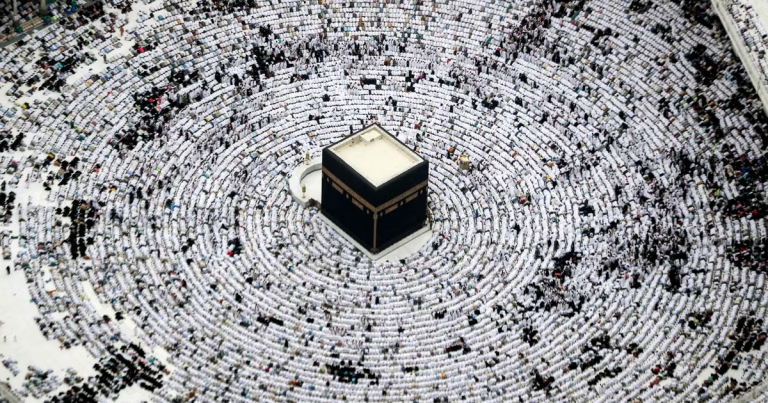
Since we spent most of this episode in the Muslim world, I wanna end the episode in Mecca, Saudi Arabia. Most of you know that Mecca serves as the religious capital of the Muslim world, the spiritual nucleus or focal point around which Islam revolves, both literally and figuratively. It’s been called the fountainhead and cradle of Islam. Mecca is the birthplace of the Prophet Muhammad, but it’s also the site of the
47:13
Kaaba, holiest shrine or mosque. In Islam, there are five pillars, five pillars known as the five pillars of Islam and they constitute the core practices of the faith. They include number one, declaring one’s faith, two prayer, three almsgiving, four fasting and number five, Hajj or pilgrimage.
47:41
It’s this last one that’s fundamental to Mecca. So according to this pillar, all adherents of Islam are required sometime during their life to make the pilgrimage to the Kaaba. Before they can enter the holy sanctuary, they must take off their regular clothing and put on two white sheets so that there’s no class distinction between pilgrims. They’re expected to enter the sanctuary in a state of purity
48:10
known as Iram. And they do this by quote, performing cleansing rituals in wearing the prescribed Iram clothing. Inside the sanctuary, the pilgrims are expected to circumambulate the Kaaba. Now the Kaaba is a large black, perfectly squared stone building in the center of the mosque. This building is believed by Muslims to be
48:39
the house of God. The literal meaning of the word Kaaba is cube because that’s what it is. It’s in a perfect cube shape. Some other time we’ll talk about this aspect of the Kaaba. But for today it’s worth noting that in the Quran the Kaaba is also referred to as Al-Bait which means the house or Betel which means my house as well as Al-Baital Al-Haram.
49:08
which means the sacred house. Karen Armstrong, she’s a scholar of comparative religion and she notes that during quote Muhammad’s era, it was venerated as the temple of Allah, the high God. And she actually says that, the high God at the end. The Quran states that Allah’s house was originally built by Ibrahim and Ismael.
49:37
which is Abraham and Ishmael, upon Allah’s instructions. So God commanded them to build this temple. The Quran 22 verse 26 reads, quote, behold, we gave the sight to Ibrahim of the sacred house, saying, associate not anything in worship with me and sanctify my house for those who compass it round or stand up or bow.
50:05
or prostrate themselves therein in prayer. It’s what’s inside Allah’s temple or house, the Kaaba, that’s of great importance to today’s episode. See, inside the Kaaba, Muslims house a very sacred stone known as the Black Stone. Muslims believe that this stone fell from heaven and marked the spot where Adam and Eve
50:34
were to build an altar. And keep the altar aspect of this Islamic belief in your back pocket. Muslims believe the Prophet Muhammad in 605 AD placed this black stone in the east corner of the Kaaba, where it still sits today. And you can see it there. Islamic pilgrims, like we talked about earlier, when they enter into the sanctuary, they start a ritual referred to as the Tawa.
51:05
In this ritual, they ritually circumambulate the Kaaba. And they start at the eastern corner where the black stone can be seen through a silver lined portal. At the end of each circuit, the pilgrim reaches towards the stone to try and touch it or kiss it. And they recite, God is greatest. In the modern day, there’s so many people that are trying to do this, that it’s now acceptable for the pilgrims to just kind of point in the direction of the black stone each time that they complete a circle.
51:35
after they’ve completed seven circles around the Kaaba, after they’ve touched the black stone seven times and recited seven times, God is greatest, then the Tawaf is complete. In a future episode, we’ll talk about why they do this seven times, because that’s important. For the purposes of this episode, it’s important to point out that within the Islamic tradition, it’s believed that this stone, which Muslims believe, was originally dazzling white.
52:05
but that it’s since been tainted black by the sins of pilgrims, fell from heaven as a way to mark the spot where the first altar and the first temple on earth was to be built. From this and the other things that we just discussed, it’s obvious that we’re getting the same symbolic picture here with the Kaaba as we did with the Greek Omphala stone. In both places, we have a sacred stone, a sacred center where God dwells,
52:35
and the establishment of a temple in that place. I hope that this far into the podcast that you’re really starting to see how widespread and deeply embedded the theology of the ancient tradition is in the world’s myths and legends and folk tales and in the world’s iconography and sacred architecture. It doesn’t matter if we’re in Venice, ancient Greece or Saudi Arabia, it’s telling the same
53:05
story.
53:08
That’s it for me. I’ll leave you with the words of William Shakespeare. Knowledge is the wing we’re with when we fly to heaven. I’m Jack Logan.
53:23
You’ve been listening to the Ancient Tradition. A Wonk Media Production.